
FARNBOROUGH GOSPEL HALL
The article below was collected by the late Paul Rason, and is produced here from his archive. It expands on an earlier one that is reproduced in the side panel. The author of that account is unknown, but from the narrative concerning the final agreement with the Plumbridges to acquire the land, it would appear to have been written around 1965.
This article refers to the formation and development of 'The Brethren' in Great Britain and Ireland from the early nineteenth century. However the origins go back further, and are complicated by subsequent division, see this Wikipedia Article
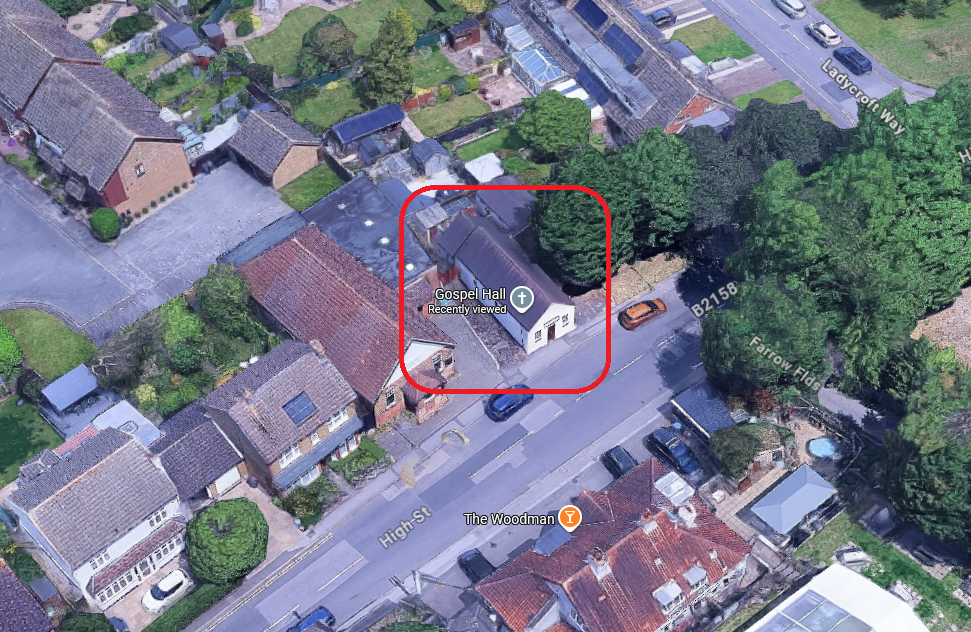
Church Road today, with the Gospel Hall highlighted,
click to enlarge
The Brethren
The 'Brethren' was founded in Dublin in about 1827 led by the Reverend John Nelson Darby. The movement had been formed following a growing dissatisfaction that the Church of Ireland (and England) and the Catholic Church no longer represented the simple beliefs and truths in the Bible, but had allowed too many man made traditions and practises and formality to be introduced into church services. The Methodists had similarly been formed in 1739, separating from the Church of England in 1795. The 'Brethren' could therefore be seen as the fore-runner of the evangelical 'free churches' that were started and became popular in the latter decades of the 20th century.In 1831 the Brethren movement spread to England with the first church established in Plymouth, hence the title 'Plymouth Brethren' being commonly used for subsequent churches. Since then 'Open Brethren' has been the name adopted by many, emphasising that there is no secrecy or restriction, all being welcome to the church services. Today 'Christian Brethren' is an alternative name as so few people have heard of the other names. Whatever the name used, the basic Christian message as written in the Bible is preached and followed. Ageing and dwindling congregations in recent decades had seen the countrywide network of often once thriving churches much reduced as churches have closed.
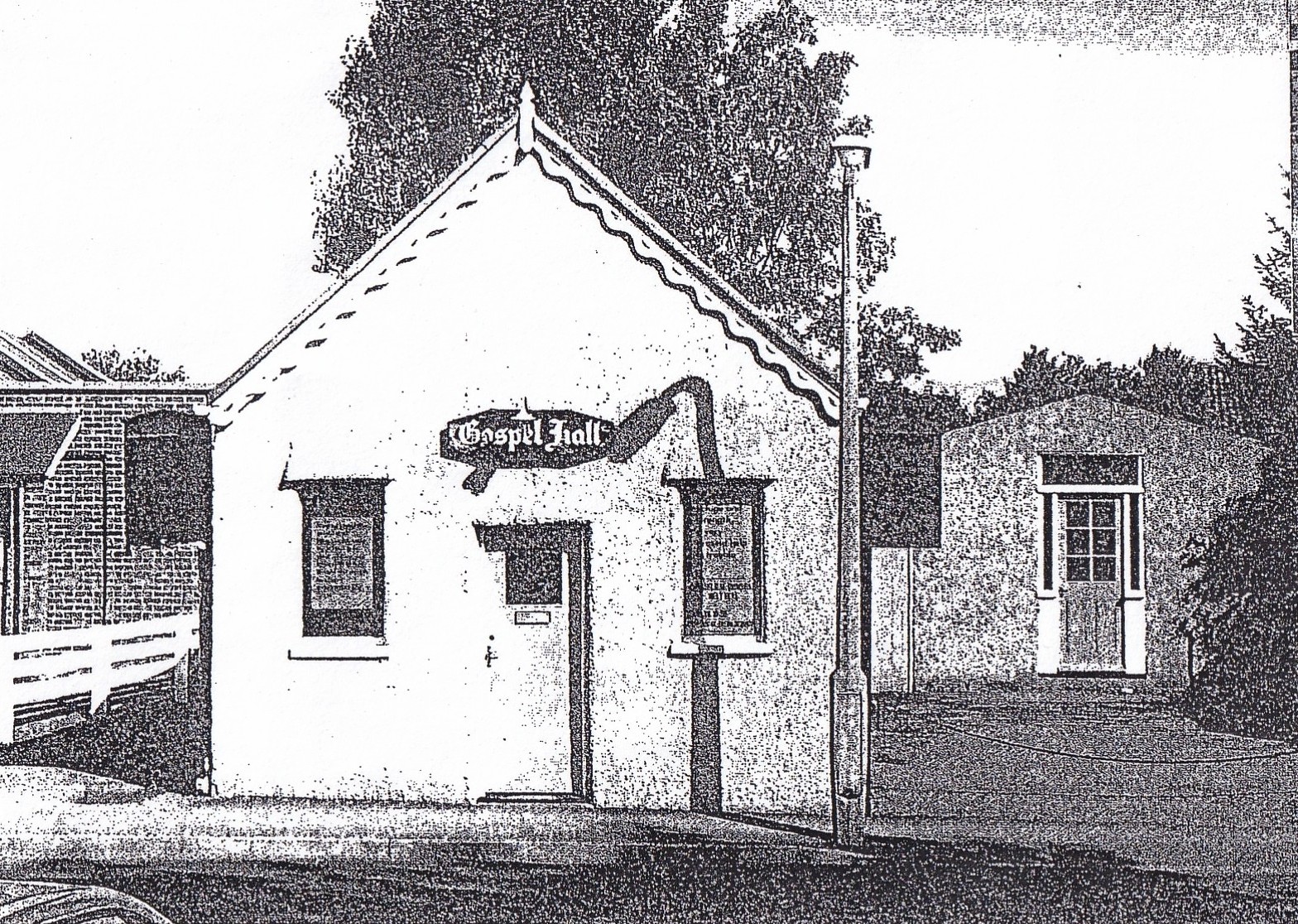
The origin of the 'Gospel Hall' in Farnborough is very poorly documented, perhaps reflecting the priorities of 'The Brethren' that people are more important than the mere buildings in which they meet to worship God. The building was certainly in existence in 1883 when it received its only mention in the 'Bromley Record' (at least between January 1878 and December 1887), which we shall come on to later. Bush's Directory of Bromley is of little help, not including it until 1896! No records have survived within the church and the earliest known account of its history was only written in 1964, which incidentally is the date of the earliest known photograph of the building! - see the side panel.
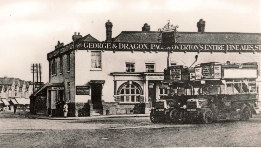
Farnborough seems to have been ignored in general by early photographers, the relatively few known photographs of the village tend to be of the area around the 'George and Dragon', or the Green. The writer of the history in 1964 had similar problems to me, in that no definitive version was available, with various versions passed down by word of mouth to choose from. Recent research in Bromley Local History Library has produced next to nothing, and so the following is the most likely course of events, supported by collaborative evidence where possible.
Graham Sanders
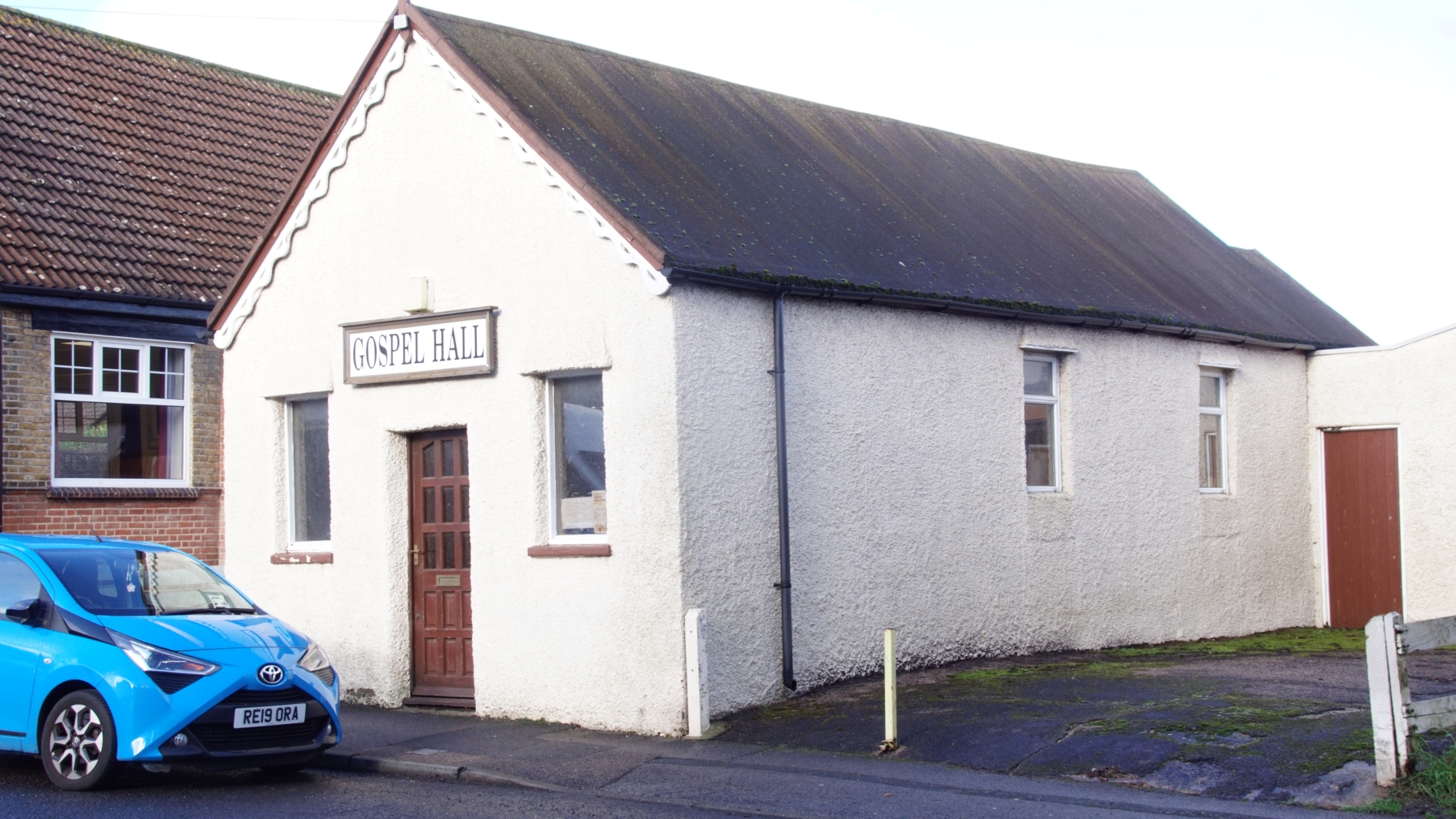
The Gospel Hall today
A History of Farnborough Gospel Hall
In the period around the 1870's the scourge of the time was not drugs, but alcohol. With living conditions for the 'working classes' harsh, too many men were spending too much of their low wages on drink to escape the realities of life. When the public houses closed at night they returned to their starving and destitute wife and children with little or no money for housekeeping. Excessive drinking also led to boisterous behaviour and violence, against wives as well as amongst themselves. Opposition to this came principally from the non- conformist churches, ably championed by the Salvation Army formed in 1878 by William Booth. Their efforts were not welcomed by the vested interests of the brewing trade and publicans, nor their customers who frequently resorted to serious violence against the Salvation Army and their kind.The instigator of opening the chapel in Farnborough is agreed to be James William Condell Fegan who had worked in the City of London for a firm of colonial Brokers. His conversion to Christianity in about 1869 led to a change of values, with his concern for providing a better life for the street urchins and orphan boys. He established his first orphanage for boys in 1870, soon to be followed by others. Latterly his work was concentrated at Goudhurst where a large farm was purchased in 1911 on which orphaned boys were trained in aspects of agriculture prior to placing them in Canada; there to start a new life with hopefully at least memories of the Christian teaching they had received.
James Fegan would have had no contact with Farnborough were it not for his parents moving from New Cross to Laurel Grove, Downe by 1880. Following the death of his father in 1881 his mother moved within Downe to Pond Houses until her death in 1883. James was a frequent visitor to his parents and involved himself in the spiritual improvement of the area. Leonard Harman writing a history of James Fegan in Bygone Kent, Vol 6 no 5 includes a letter from James's friend Charles Darwin (1809 - 1882) including the passage "We have never been able to reclaim a drunkard, but through your services I do not know that there is a drunkard left in the village". From this it is reasonable to surmise that his enthusiasm would have spread beyond the village of Downe to include Farnborough, which supports the account of his involvement in the history written in 1964.
The Erection of the 'Iron Rooms'
1879 is the date
given in two versions of the history of the Gospel Hall, as the date the
chapel was erected in Farnborough. It is said that the building
originally stood in Beckenham, but becoming surplus was purchased,
dismantled and re-erected in Farnborough. 'Iron Rooms' were a conman
sight in most districts and often known by that name. Whether it did
once stand in Beckenham unfortunately cannot be verified; the Beckenham
Journal Newspaper being as comprehensive as its Bromley version in news
coverage makes no mention of any such event. It does however reveal that
Beckenham at this time was full of Iron Chapels. The coming of the railway to Beckenham in 1858 started a boom in house building, with the population increasing six-fold by 1881. The new church congregations frequently purchased an Iron Room 'kit' in which to quickly and cheaply start up whilst saving for a permanent brick building. The moving of these Iron Chapels was also not uncommon.. Another factor in the flourishing church building in Beckenham at this time was the vibrant temperance movement in the town. According to Bush's Directory of Beckenham (which is not that accurate datewise nor comprehensive) several church buildings disappeared, at about that time including the Iron Church (Holy Trinity in The Avenue); St- Agatha's at Kelsey Park; School Chapel and Mission Hall, Alexandra District; and the Iron Church in Upper Elmers End Road. Whether our building was one of these will probably now never be known.
The Plumbridge Connection
The land on which the chapel was erected in Farnborough belonged to the local farmer W. Thomas Plumbridge. A fruiterer with a business in Fleet Street London, he was possibly known to James Fegan prior to his decision in 1876 to cut out the 'middle man' by growing his own strawberries for sale in his London shop. He therefore moved to Farnborough and purchased his own farm. Read More HereFarnborough at this time was noted for its widespread growing of strawberries, being close enough to London to transport the crop quickly to the customers, even by road. Vast quantities of horse manure from the abundance of stables in the capital traveled in the opposite direction to fertilise the crops.
Mrs. Plumbridge is known to have been an active temperance worker, so would have willingly assisted in the setting up of the Iron Room. The success of her pledge signing activities and the Band of Hope meetings held in the chapel so incensed some local people they attacked the building, breaking all the windows.
Where the 1964 account differs from recent research is in the assumption that 'The Brethren' started the first church services in the chapel. This is put into doubt by a different version of events which is supported by the only references from 'The Bromley Record', for October and November 1883. The November edition contains a letter from Edgar Gale Butler refuting the rumours that the dissolution of the Farnborough Branch of the Salvation Army had taken place, and that the hall in which the services were held is for sale. His letter includes the lines: "As I have supported the Mission there since its commencement, I beg to state that services have been held every Sunday since it was opened, and there are, I rejoice to say, many of the people in the village who show by their - altered lives what God has done for-them, drunkards have become sober and homes made happy. I have recently engaged Mr. R.H. Newman (late Staff-Sergeant, Army service corps of Woolwich) to take charge of the work there, and he will be glad of the help of the Bromley Christians".
Edgar Butler therefore seems to have been involved from the beginning, to what extent he, rather than James Fegan took the lead is unclear. With the Salvation Army only being formed in 1878, Farnborough was an early part of their work. When the Salvation Army left Farnborough is not recorded, although the date of around 1885 is agreed most likely, The opening of a Salvation Army barracks in Bromley at the Vale, Masons Hill on 1 September 1886 would seem of relevance.
Following the Salvation Army leaving the Iron Room, news must have reached James Fegan, although he no longer had connections with this area. The story is that in response to a 'tent mission' being held in Farnborough and encouraged by the response, James Fegan arranged to take over the empty building and commence a regular assembly of 'Open Brethren' with the support of the Plumbridge family. Mr F.D Holloway, secretary to Mr Fegan's children's homes who lived in Norwood, spent the weekends at Farnborough to take an active part in the running of the meetings. ('The Brethren' do not have a single minister. or pastor in charge of the congregation. The work being all done by elders and any within the congregation who are gifted by God to lead the service).
Bush's Directory of Bromley for 1900 shows church services on Sundays at 11.00, 12.00 and 6.30pm, and at 7.30 on Wednesdays, with Sunday school at 9.45am and 2.30pm.'Key kept by Mr. R.Rich (opposite the hall) where letters etc. may be left'.
You will note I have been referring to the building as the 'Iron Room'. Iron Rooms (or colloquially 'tin chapels') as the name suggests were constructed of corrugated iron on a timber frame. Corrugated iron was in the latter 19th and early 20th century the great invention of the age, enabling strong, lightweight buildings, to be easily and cheaply constructed, The number of chapels and village halls throughout England and Wales of similar or identical design- a few of which still survive, some even in near or original condition in rural areas even if no longer used for their original purpose, leads one to conclude they were bought and assembled using standard mass produced pre-fabricated parts, just like a child's construction-set. A good local example is Pratts Bottom village Hall, still in use. The number of parts purchased was determined according to the required size and budget. Similar construction (although not using the 'chapel kits') was also employed for farm buildings and some rural railway stations, as still seen today on the Kent and East Sussex Railway.
As stated, the land on which our building was erected was provided by the Plumbridge family, in return for a small annual sum as ground rent. The subsequent building of the new housing estates next to the hall in the 1960's created complications as the original lease had long expired. Attempts to renew it always met the response that the land would never be sold to anyone else. Nevertheless, the payment of the ground rent had continued. In March 1964 Edward Plumbridge, grandson of the original, finally agreed to legalise the position and sell the land on which the hall stood to the Trustees of the Gospel Hall for a nominal sum of £1.
The name 'Iron Room' was dropped in 1926, probably as it was felt no longer suitable, thereafter the building was known only as the 'Gospel Hall' (the name used by the Brethren for all their chapels). Many older inhabitants of Farnborough continued to refer to the building as the 'Iron Room' and by an apparent oversight it remained registered under that name as a place of worship with Bromley Council until July 1973.
Attempted move to Church Road
By 1934 it was recognised that the hall's condition was 'worn out' and thoughts turned to a new building. In 1936 planning permission was sought for a new 'temporary' building in Church Road but this was refused by Orpington Urban District Council. The location was where the public conveniences were to be built in 1946/47, the cottage on that site, which had been one of Farnborough's Dame Schools being in a dilapidated state. The term temporary, most probably refers to pre-fabricated building rather than one of brick.. Although the public conveniences have long gone, to be replaced by a new private dwelling at the same location, the site is also still home to the St. Giles Centre alongside.This OS 6 inch map from 1938 shows both the original location for the Gospel Hall, in red, and the proposed site in Church Road in blue. click to enlarge
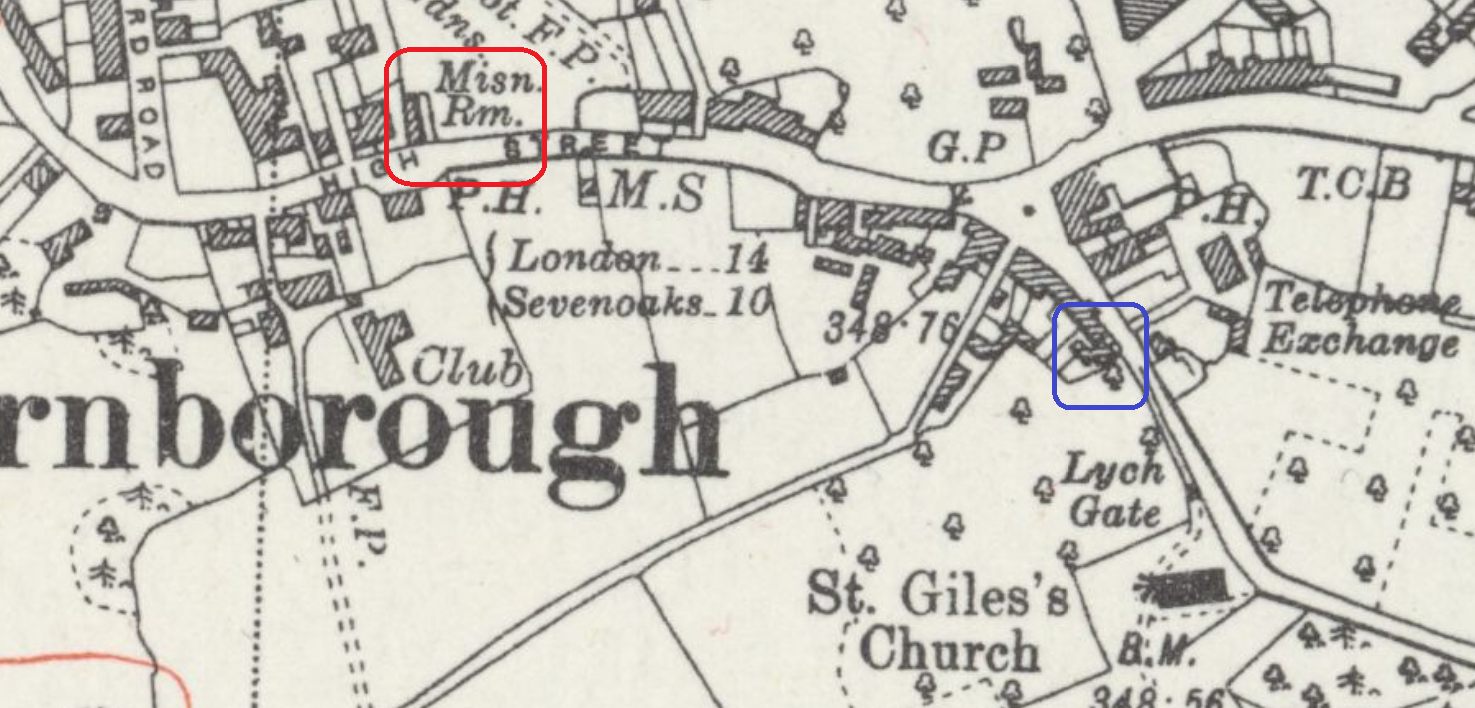
Undeterred, the Farnborough Gospel Hall Building Committee tried with a fresh application for the same site in June 1937. Orpington UDC had concerns at the design submitted and also the lack of a car park as part of the plans (yes, even in 1937 car parking was perceived to be a problem). The application was not pursued, although Orpington UDC had not dismissed the proposal completely, and met the committee to discuss changes. The lack of space for a car park was perhaps the main obstacle, a problem to re-occur 30 years later.
Refurbishment
With no option but to remain on the existing site next to the Village Hall, improvements were made including the refurbishment of the existing building, which included coating the exterior walls in rendering which concealed the corrugated iron (internally the walls had always been clad in timber). In 1938, outside toilets were added - I will leave the reader to speculate how the congregation managed before! But then most parish churches still lack these facilities.By the 1960,s the structure of the hall was again causing concern and fund raising began for a new building on the existing site. Architects plans were drawn up, including one design for an elevated structure on stilts as the only means of providing car parking on the restricted size of the site - the provision of a car park being a pre-requisite for planning permission for any new structure. The anomaly of planning permission is that any existing structure has planning permission (albeit many years earlier when different rules applied!). The various alternative plans were all refused by the council, with the final attempt being in February 1972. The decision was then taken to retain the existing building but extensively refurbish it inside and out, thus overcoming the problem of no car park. The sideways were however levelled and concreted over to provide space for cars.
The work now undertaken included replacing all the interior wood panelling on the walls and also replacing the wooden floor. The high ceiling was lowered with a false ceiling concealing the wooden rafters, new lighting provided and the underfloor baptismal pool re-tiled. The exterior walls which still retained the corrugated iron underneath were re-coated in cement and new windows installed. Little therefore remained of the original nor the 1930's refurbishment, and certainly nothing that was visible. The work commenced in March 1973, the hall being officially re-opened by an afternoon of special church services and a sumptuous tea for all those attending on 4th August 1973, - although the hall had actually been first used again the previous Sunday. During the work, church services were held in the small annex next to the main building, which proved a tight fit! This had started life as a domestic 'portable' pre-fabricated garage donated by one of the congregation just after the Second World War, initially to house the thriving Sunday afternoon Bible Class. The work on the main hall and kitchen now completed, this annex then received similar refurbishment - so much so that its original austere appearance is no longer recognisable.
Evangelical tent missions touring Kent and the South East of England preaching the Word of God, of the kind that had prompted the formation of the Gospel Hall back in the 19th century continued to be actively supported. Their last visit was in the mid - 1970's when their large tent in which services were held was pitched in the field next to 'The Woodman' (opposite the Gospel Hall). It was following one such mission in 1935 that a regular women's meeting commenced in the Gospel Hall.
In the days before mass car ownership and foreign travel, when life was simpler, but tough (especially for those in inner London and the East End), a Sunday afternoon in the country was a treat and a chance to escape the squalor and pollution. The 47 bus route between Shoreditch and Farnborough was a simple and easy means of travel for the thousands who each summer made the journey until the mid 1950's.
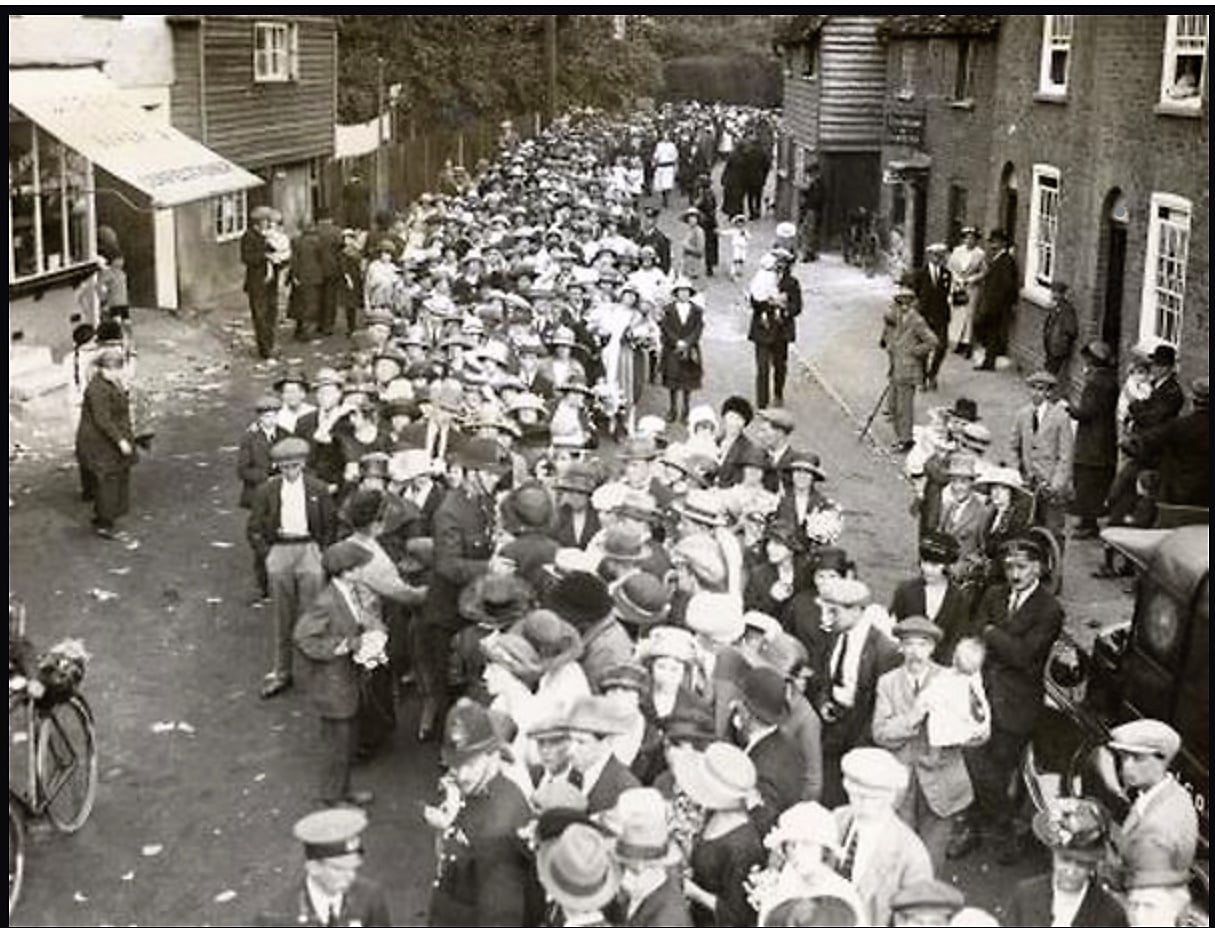
Farnborough had its most frequent service on summer Sunday afternoons, a bus every 4 - 5 minutes. The queues for the return journey stretched right down Church Road. The Gospel Hall congregation anxious to spread the message of salvation to the waiting masses would hold open air meetings at the 'George and Dragon' bus terminus at this time. The failure of the 1930's proposal for a new chapel at what would have been an ideal location adjacent to the bus stands in Church Road therefore proved to be no obstacle!
Until the mid 1970's the 'Gospel Hall' had a thriving Sunday school and young peoples work, a highlight of which was the annual outing, usually to the seaside. Bexhill was a popular destination in the 1960's with one of the Maidstone and District's impressive modern Leyland 'Atlantean' double deckers being hired from Tunbridge Wells garage. After a day on the beach and exploring the town, children and those parents that accompanied them, would gather for tea on the lawns of Egerton Park before the journey home. Hopefully by then all those children that had got lost during the day had been found, rescued from the island in the boating lake, or reclaimed from the police station where they had been taken to await collection.
Earlier in the century the Sunday School outings were perhaps less ambitious, large horse-drawn brakes taking the children to that other notable local tourist resort (in addition to Farnborough) - Keston Common. The organised games and a tea were no doubt no less enjoyable, but only available to those who had attended every Sunday during the past year. '
The link with Mr. Fegan continued after his death into the 1970s as the weekly collections taken at the Sunday School were donated to the orphanages he had founded in the late 19th century. The Gospel Hall Fellowship continues to support Fegans Homes financially to the present day. Today, church services are held every Sunday (God willing) at 10.30 a.m. to which all are welcome.
As stated at the beginning, the origins of the 'Gospel Hall' were poorly recorded at the time, unless you know differently. An added mystery is that the first large scale Ordnance Survey map published in 1871 shows buildings on both this site and also the adjacent village hall, although the shapes are different. The Village Hall was not built until the 1890s.
FARNBOROUGH VILLAGE
Farnborough Gospel Hall
In July 1973, the name 'Gospel Hall. was re-registered with the London Borough of Bromley as being the same building as the 'Iron Room'
There are not many photos of the Gospel Hall generally available, but these have been located in a private archive
Click to enlage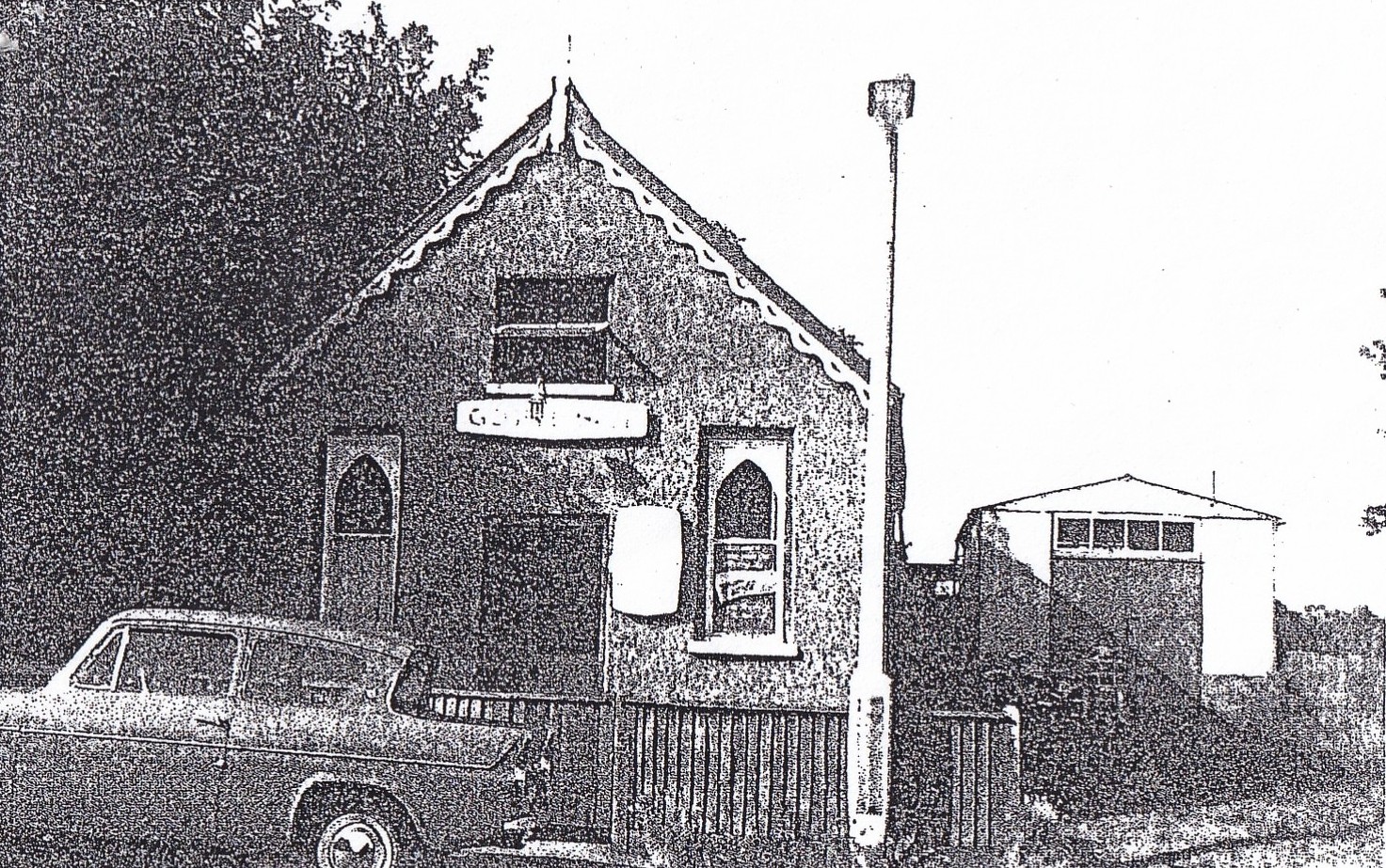 Summer 1964
 August 1989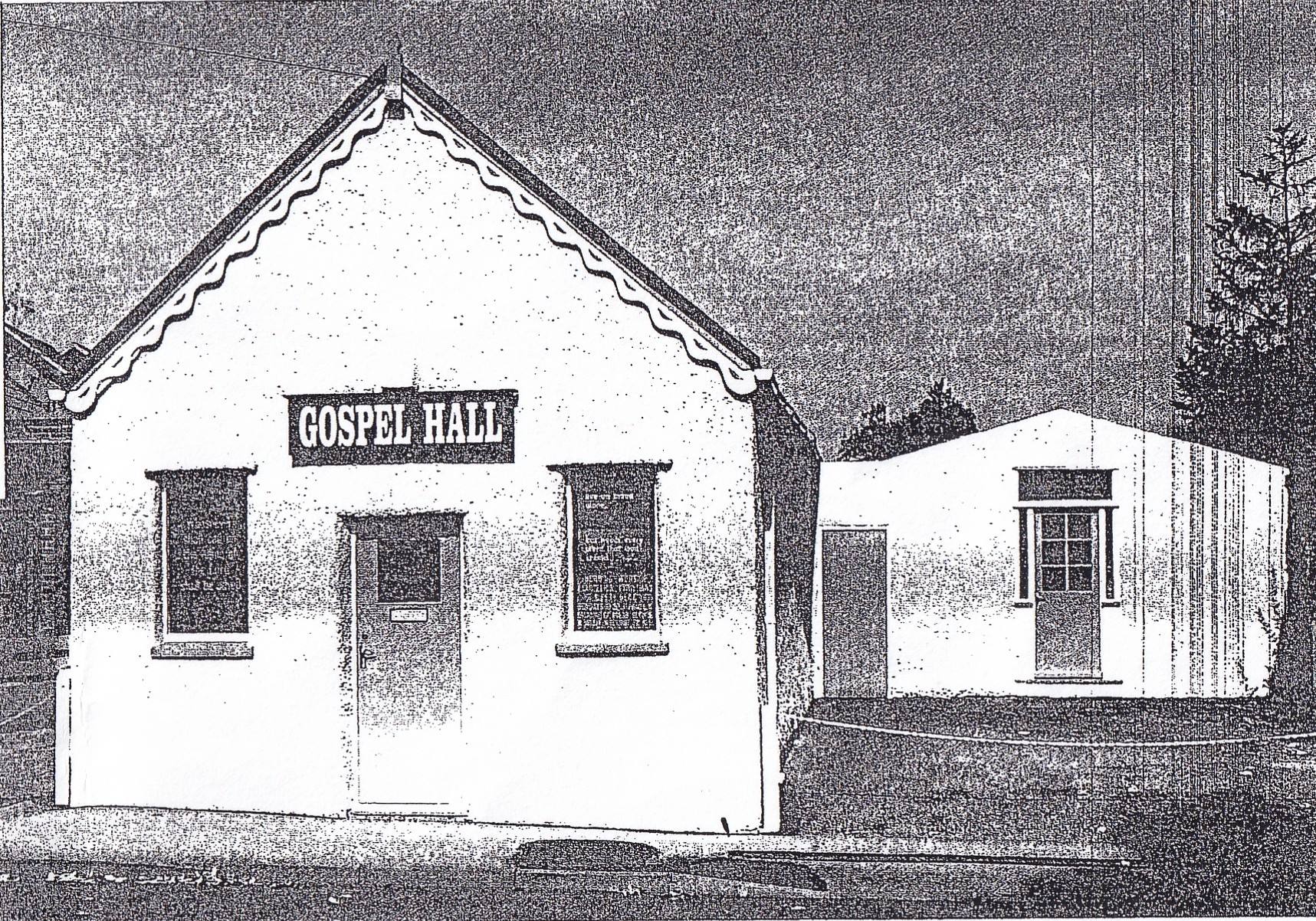
September 1993
It seems strange to think that strawberries could have anything to do with the commencement of a Gospel work, but such is the case at Farnborough.
The article below was written in about 1965, the identity of the author is unknown.
Gospel Hall and Strawberries
In the year 1878 a fruiterer.. a Mr. Plumbridge, with a business in Fleet Street, decided that it would be a good idea to grow his own strawberries so that really fresh fruit might be on sale at his shop. With this in mind he moved to Farnborough and purchased land which was to become the Plumbridge Estate.There would seem to be differences of opinion as to how the work at the Gospel Hall started, but it seems certain that the late Mr. Fegan (Orphanage-Homes) was the instrument used to commence the labour of love that has seen many years of faithful service.
It would seem that Mr. Fegan was known to Mr. Plumbridge, and that in the year 1879 purchased at Beckenham, a timber and corrugated iron building, dismantled it, and had it re-erected on its present site.
The present owner of the estate, a grandson of the original Mr, Phumbridge, himself attended the Sunday School from 1896 onwards, and tells many interesting stories of early days. It would seem that his mother was an active temperance worker, and that local people incensed by the success of her pledge signing activities, and the band of hope meetings held in the 'Iron Room' as it had become known attacked the building with stones and broke all the windows.
For many years Mr. F.D, Holloway secretary to Mr. Fegan's homes, who lived. at Norwood, spent the weekends at Farnborough to carry on the work.. In fact, though he was not still able to come, he carried on booking speakers right up until 1924. In that year, Mr. Charles Flint of Catford came to live in Orpington, and carried on the work until 1931, when he was called home,
During 1926 a Mr. Kurn joined Farnborough, and as at that time there was no Sunday School, this was re-opened by them in July of that year. Mr. Kurn became responsible for the work on the passing of Mr. Flint - continuing right up to his removal to Worthing early in 1936.
The womens meeting was commenced, in 1935 after the tent mission in the district.
A flourishing Bible Class was held on Sunday afternoons, and many of the young people concerned have grown up to become active in the Lord's work. The annex was erected just after the last war to accommodate this class.
After Mr, Kurn moved to Worthing, Mr. Collar carried on the work until he too moved to Boscombe early in 1959..
The original lease that was drawn up, required payment of a small annual sum as ground rent, and. though this lease expired long ago this arrangement has continued.
With no written agreement, for many years it has been felt that there was no security of tenure. As a consequence several approaches have been made to Mr. Plumbridge with a view to either purchasing the site or having a fresh agreement drawn up. this Mr.Plumbridge had always refused to do, giving the assurance that should anything happen to him, his son would always look after our interests. As recently as last year when the land surrounding was up for planning permission, Mr. Plumbridge gave a promise. that he would not sell our land.
A few weeks ago Mr. Plumbridge called us together to tell us that he was making us an offer of buying the freehold of the site at a cost of £1. This sale has now been carried out.
It has been noted from a letter written in February 1934 that the hall at that date was in a condition then described as 'worn out'. Several attempts have been made, and much money spent, in an attempt to prolong the life of the "Iron Room" and to give it a 'face lift'. In recent months much thought has been given to the problem of repointing or re-building, and if re-building, how and where?
Surely God has answered the where! We look to him to show us how.
God has blessed us by bringing in new workers, and by giving us new channels of service, in particular perhaps a work among old people.
We look to him ln faith for a new building to carry out his work.